Table of content Table of content
During a recent demonstration, the US Navy showcased the effectiveness of new equipment designed to counter “uncrewed aerial threats,” more commonly known as drones. These devices have become increasingly common in modern conflicts, where they can be used to launch strikes quickly and with relatively low cost.
A new anti-drone system tested at sea
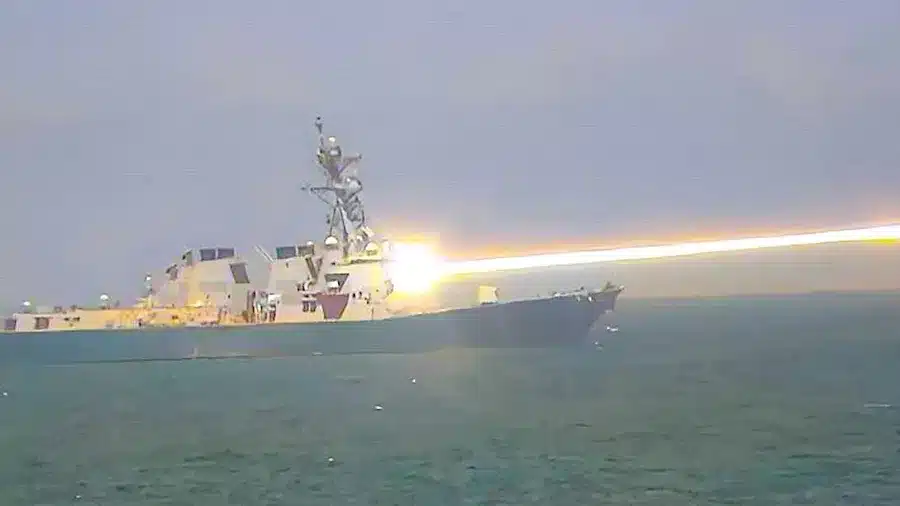
According to an article from The War Zone, the USS Preble (DDG‑88), an Arleigh Burke‑class destroyer, successfully destroyed four drones during a test using a laser weapon developed by Lockheed Martin. The system, known as HELIOS (High Energy Laser with Integrated Optical Dazzler and Surveillance), was confirmed by the company’s CEO, Jim Taiclet. “Speaking of amazing technology, we successfully used the shipboard laser system, Lockheed Martin’s Helios, to knock an incoming UAV right out of the sky.” Taiclet said.
He added that the system neutralized four targets during the demonstration, illustrating how directed-energy weapons could help preserve traditional air-defense missiles for more critical threats. The HELIOS (High Energy Laser with Integrated Optical Dazzler and Surveillance), also designated Mk 5 Mod 0, is a 60-kilowatt directed-energy weapon designed to destroy or disable drones and small boats. In addition to its destructive capability, the system can also function as an optical dazzler, allowing it to blind or disrupt enemy sensors.
The USS Preble (DDG‑88), which has carried the system since 2022, is currently the only US Navy ship equipped with HELIOS. Other vessels have received lower-powered dazzler systems such as ODIN (Optical Dazzling Interdictor, Navy), while additional high-energy laser systems remain in experimental stages.
A promising but still limited technology
The demonstration reportedly marks the first confirmed engagement involving multiple targets with the HELIOS system. The US Navy has been increasingly interested in directed-energy weapons as a way to defend ships against short-range threats such as drones. Recent military operations in and around the Red Sea have shown how swarms of drones, combined with cruise and ballistic missiles, can overwhelm conventional air defenses. One of the key advantages of laser weapons is their virtually unlimited firing capability, as long as ships have enough electrical power and cooling capacity.
They could also significantly reduce costs. For comparison, a single RIM‑116 Rolling Airframe Missile used on US Navy ships costs roughly $1 million. However, several challenges remain. Laser weapons can only engage one target at a time, their effectiveness decreases with distance, and their performance can be affected by weather conditions such as fog, smoke, or dust. Naval systems must also contend with saltwater exposure, rough seas, and demanding cooling requirements.
Source: TWZ